Gaze-Driven Adaptive Learning
Designing a system that adapts reading content based on real-time gaze data to improve engagement and comprehension
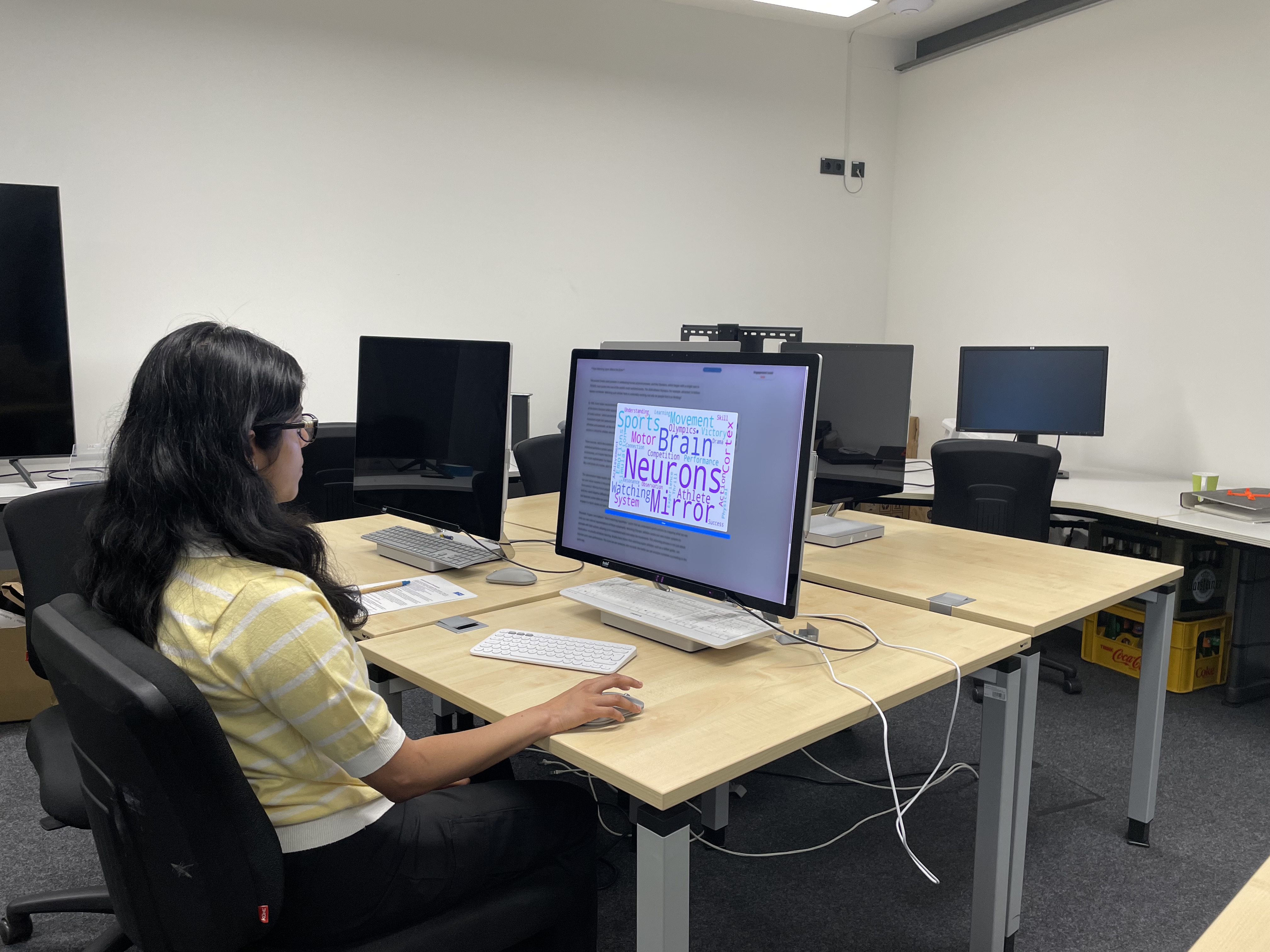
Overview
For my Master's thesis at RPTU Kaiserslautern (in collaboration with DFKI), I studied how semantic priming and real-time adaptive interventions can improve comprehension and engagement in online learning environments. Using eye-tracking and behavioral measures, I analyzed both learning outcomes and process-level changes to understand how these interventions influence how people read and learn.
The Challenge
Online learning environments often present content as static text, regardless of whether a learner is struggling or breezing through. This one-size-fits-all approach fails to support learners at the moment they need it most. The question: can we use real-time gaze data to detect comprehension difficulty and intervene adaptively without disrupting the reading experience?
Research Approach
- Designed and prototyped adaptive features including AI-generated real-time summaries, interactive word clouds, and dynamic text highlighting
- Planned and conducted controlled user studies to evaluate both usability and cognitive impact of interventions
- Collected eye-tracking data (fixations, saccades, reading speed) alongside comprehension scores and self-report measures
- Analyzed behavioral data using both qualitative and quantitative methods to assess effectiveness and inform design iteration
- Collaborated across interdisciplinary teams to align research insights with interface design and system logic
Why these methods?
Eye-tracking was essential because comprehension difficulty isn't always visible in outcomes alone. Someone can score well on a test but struggle significantly during reading. Gaze data captures that process-level struggle in real time. A controlled study design let us isolate the effect of specific interventions, and self-report gave us the subjective experience layer to complement the behavioral measures.
Key Findings
- Adaptive support fundamentally changed the way users engage with and process learning content, even when comprehension score improvements were modest
- Comprehension improvements depended on factors like language proficiency, suggesting adaptive systems need to account for individual differences
- Process-level measures (reading behavior) revealed intervention effects that traditional outcome measures alone would miss
- Real-time interventions shifted gaze patterns in ways consistent with deeper processing of key content areas
Impact
This research demonstrates that adaptive support doesn't just improve what people learn; it changes how they learn. The findings contribute to the broader field of AI-enhanced learning and show how methods from cognitive science, HCI, and experimental psychology can be applied to real-world UX challenges in digital learning environments.
Reflections
The biggest takeaway: outcome measures alone (comprehension scores) don't tell the full story. Process measures (how people read) revealed effects that traditional metrics would miss entirely. Next time, I'd add a longitudinal component to see whether adaptive support changes reading strategies over time, not just in a single session. I'd also explore giving users control over when interventions appear rather than triggering them automatically.