Predictive Eye Movements under Varying Cognitive Loads
Examining how cognitive load influences real-time reading behavior to inform adaptive text-based interfaces
Overview
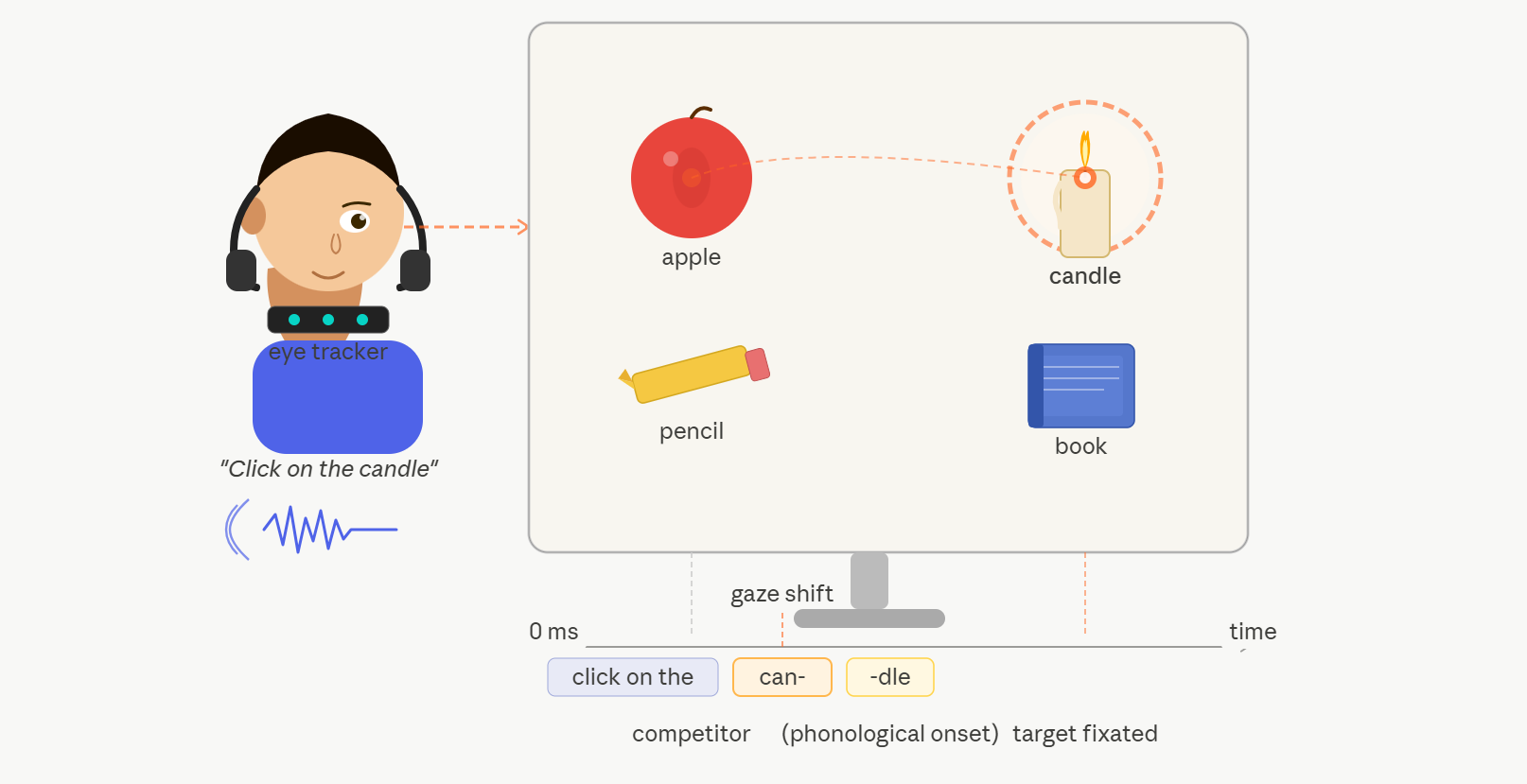
Conducted an eye-tracking user study to examine how cognitive load influences real-time reading behavior. The goal was to understand how varying demands on working memory affect predictive eye movements, and what this means for designing text-based interfaces that adapt to the user's cognitive state.
The Challenge
When users are under high cognitive load, their reading behavior changes, but how exactly? If we can identify reliable gaze-based markers of cognitive strain, we can build interfaces that respond in real time: simplifying content, adjusting pacing, or providing support at the right moment.
Research Approach
- Designed a controlled eye-tracking study with varying levels of cognitive load
- Collected gaze data (fixations, saccades, regressions) during reading tasks
- Applied linear mixed-effects modeling to account for individual differences and repeated measures
- Analyzed how predictive eye movements shift under different cognitive demands
Why these methods?
Eye-tracking was the only way to capture predictive gaze behavior as it happens. Self-report can't tell you whether someone's eyes were anticipating the next word or regressing to re-read. Linear mixed-effects modeling was chosen over simpler ANOVAs because it handles the nested, repeated-measures structure of reading data without aggregating away meaningful individual differences.
Key Findings
- Cognitive load systematically altered predictive gaze patterns during reading
- Higher load conditions led to measurable changes in fixation duration and regression frequency
- These gaze markers are reliable enough to serve as real-time indicators for adaptive systems
Impact
The findings provide a foundation for designing adaptive text-based interfaces that detect cognitive strain through gaze behavior and respond by adjusting content presentation, moving toward interfaces that work with the user's cognitive state rather than against it.
Reflections
This study reinforced that statistical modeling choices matter as much as study design. Mixed-effects models were the right call because they handle the repeated-measures structure without throwing away individual variability. If I ran this again, I'd add a dual-task condition to create more ecologically valid cognitive load rather than relying solely on working memory tasks.