Predictive Language Processing using Hand Movement in VR
Investigating anticipatory hand movements during language comprehension to inform multimodal interaction design
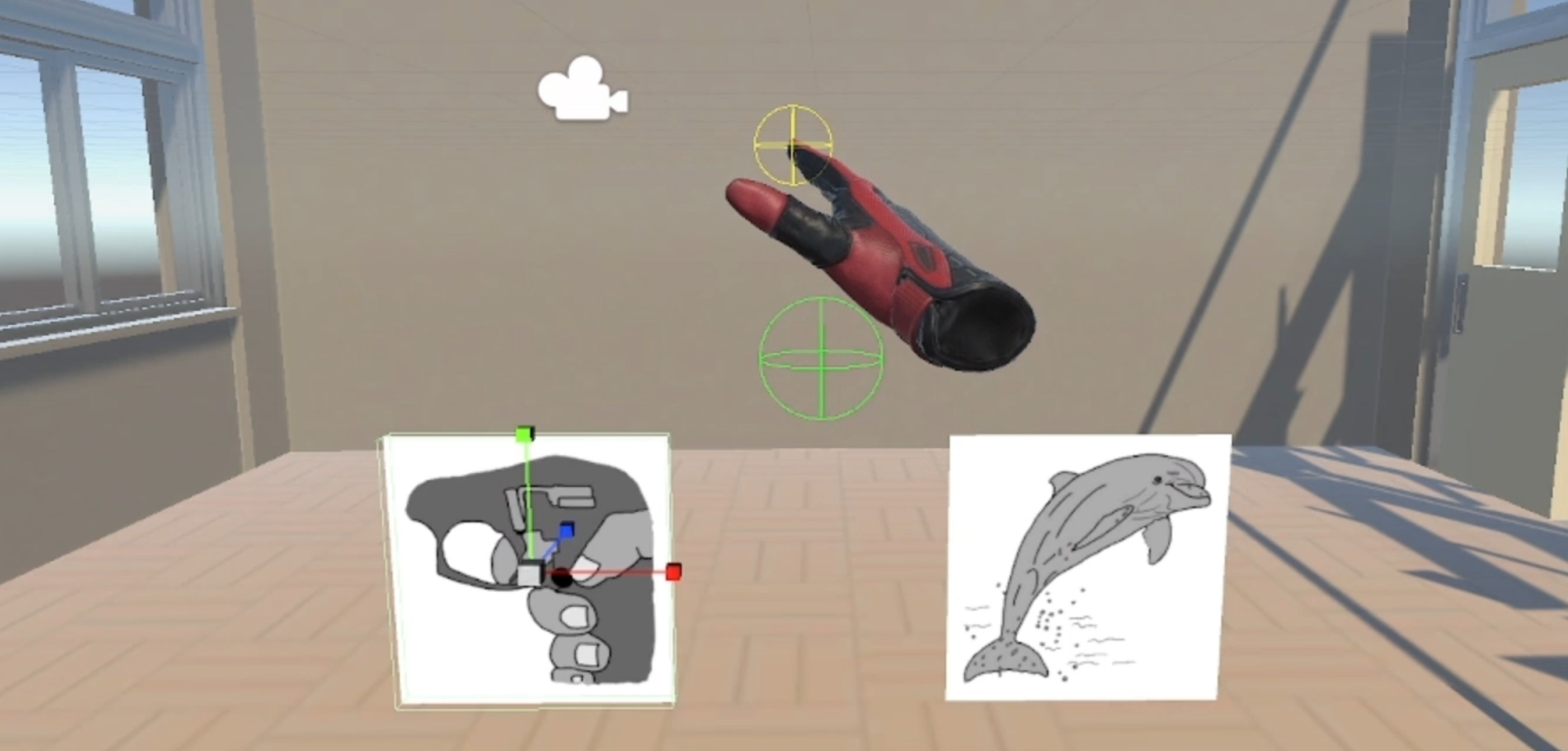
Overview
Designed and conducted a VR-based user study to investigate anticipatory hand movements during language comprehension. Using a Visual World Paradigm adapted for immersive environments, the research explored how language processing drives predictive motor behavior, and what that means for multimodal interaction design in HCI.
The Challenge
Most interaction systems wait for explicit user input before responding. But humans are predictive; our bodies begin to act on what we anticipate, not just what we've decided. Understanding how language comprehension triggers anticipatory hand movements could enable interfaces that respond to user intent earlier and more naturally.
Research Approach
- Designed a Visual World Paradigm experiment in VR where participants listened to spoken instructions while interacting with objects
- Captured real-time hand tracking data alongside the audio stimuli
- Generated heatmap visualizations to map anticipatory movement patterns across conditions
- Analyzed timing and trajectory of hand movements relative to linguistic input
Why these methods?
The Visual World Paradigm is well-established for studying language-driven attention, but adapting it to VR with hand tracking was novel. We needed VR because flat-screen tasks can't capture reach trajectories in 3D. Hand tracking (rather than button presses) gives continuous data about motor preparation, revealing the moment intent begins to form, not just when a decision is finalized.
Key Findings
- Participants initiated hand movements toward target objects before completing the linguistic input, confirming predictive motor behavior
- Movement trajectories revealed systematic patterns that varied by linguistic context and object salience
- Heatmap visualizations showed clear spatial clustering of anticipatory reaches
Impact
The findings inform multimodal interaction design in HCI, specifically how systems can leverage anticipatory behavior to create more fluid, responsive interfaces. This work bridges psycholinguistics and interaction design, showing how language-driven predictions manifest in physical action.
Reflections
This project showed me that language and motor behavior are more tightly coupled than most HCI frameworks assume. The design implication is clear: systems that wait for explicit input are ignoring half the signal. If I extended this work, I'd test whether different interface layouts change the anticipatory patterns, making it more directly applicable to interaction design decisions.